





Japanese saws cut quickly, smoothly, and are a joy to use.
What We Love About This Item:
Japanese saws cut quickly and smoothly, and are a joy to use. Great control over the cut is the result.
4.8 / 5 — 71 Verified Reviews
Built Without Compromise

Cutting on the pull keeps the blade in tension — thinner steel, straighter tracking, and a level of control that push saws cannot match.
When a blade dulls, swap it for a new one. Instant return to peak performance. Handles stay; only the blades change.
Thinner blades remove less wood per cut. Less wasted material, smoother cut surfaces, and tighter-fitting joints — straight from the saw.
Each saw is built to Garrett Wade specs — blade geometry, tooth count, and handle scaled for serious woodworking. Sold as a set at a savings over the four saws individually.
The Fundamental Difference
Western saws cut on the push stroke, which puts the blade in compression. To keep a compressed blade from buckling, it must be thick — and a thick blade means a wide kerf, more wasted wood, and more effort per stroke. You are fighting physics with every cut.
Japanese saws cut on the pull stroke. The blade is in tension — the same principle that makes a wire hold a straight line when pulled taut. A blade in tension can be dramatically thinner: less material to push through the wood, a finer kerf, a smoother cut surface, and far less fatigue in your arm and wrist over a full day of work.
The pull stroke also gives you more control. The cutting force draws the blade toward your hand rather than pushing it away, which means the saw tracks where you place it.

Four Saws, Zero Overlap
Each saw exists because no other saw in the set can do what it does. That is the test every piece had to pass.
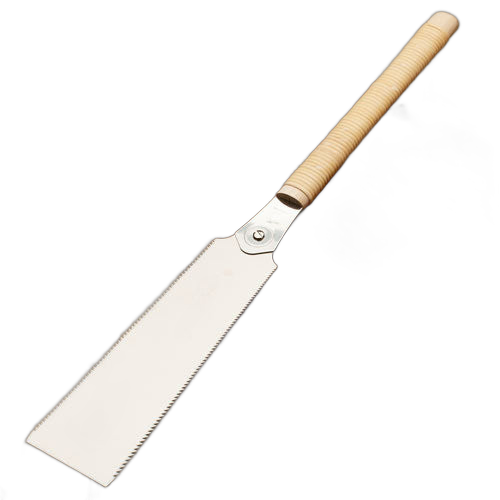
Ryoba
Crosscut + Rip
Dual-sided 9½″ blade. Fine teeth one side, coarser the other — one tool for the two most common sawing tasks.
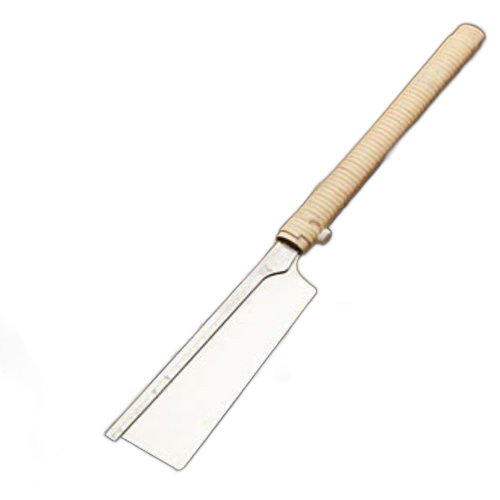
Dozuki
Dovetails + Joinery
Stiff-backed 7″ blade, 25 tpi, 1¾″ max depth. Built for accuracy where joinery demands it.
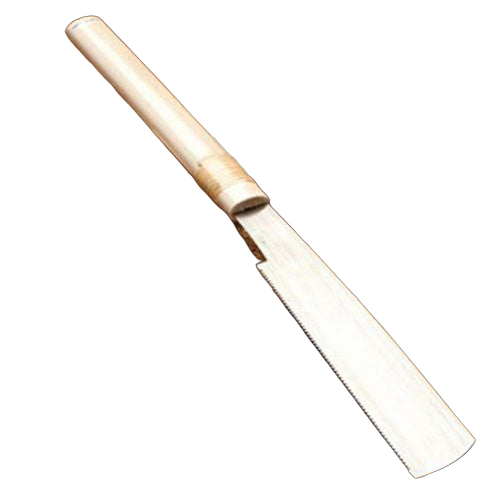
Flush Cut
Surface-Flush Trim
Flexible 6″ blade with zero-set teeth. Lays flat to trim dowels and pegs without marking the surface.
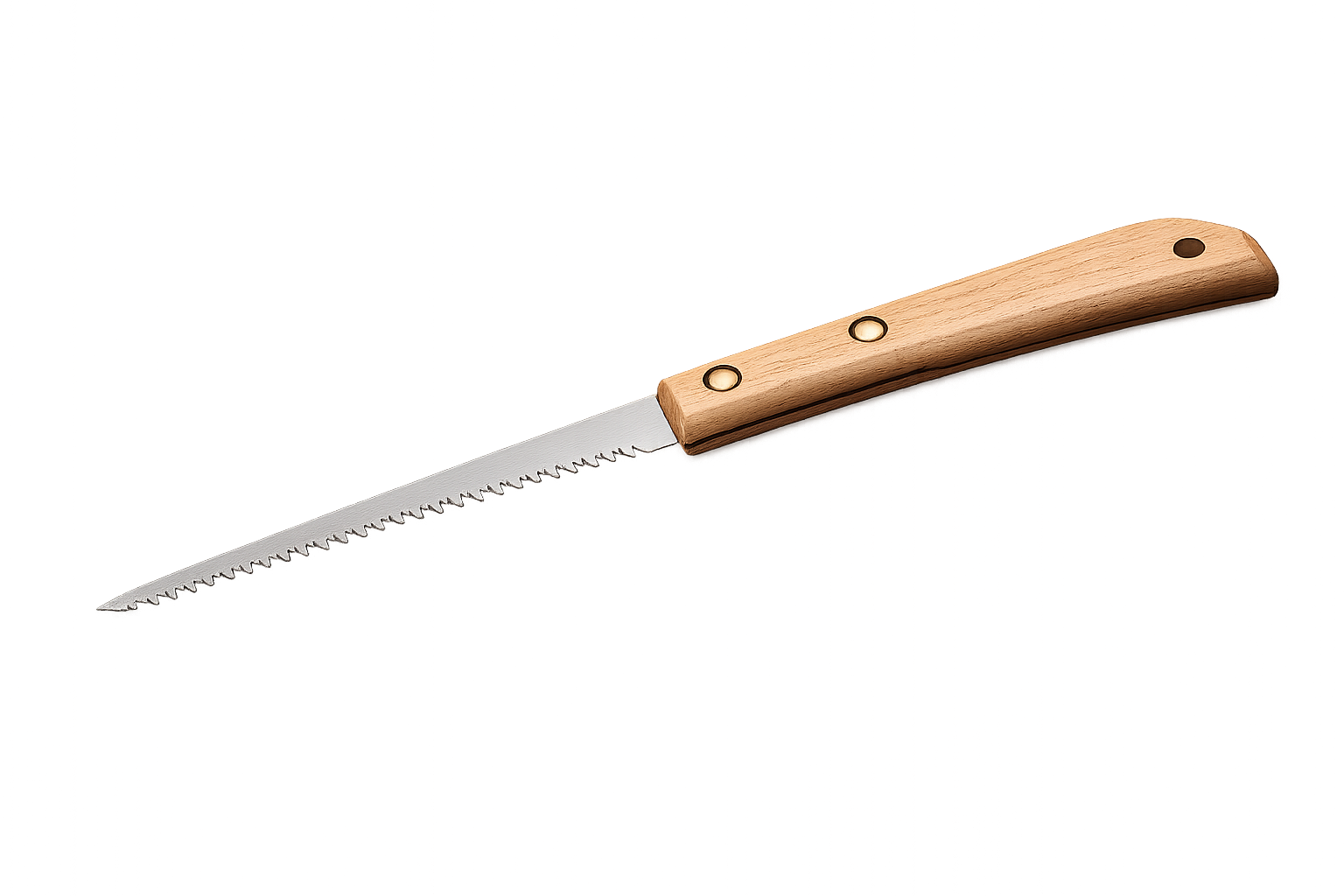
Detail Trim
Tight Spaces
5″ blade, 13 tpi, 5/16″ wide, oak handle. Reaches into spaces the others cannot.
Centuries of Blade-Making
The pull-stroke saw is not a modern innovation. It evolved alongside Japanese joinery — a woodworking tradition that famously uses no nails, relying instead on joints so precise they hold by geometry alone. The saws had to be that accurate because the joinery demanded it.
That tradition shapes every blade in this set. The Ryoba's dual-sided geometry exists because day-to-day work demanded a single saw for both rip and crosscut. The Dozuki's stiff spine exists because the dovetail demanded a saw that would not flex. The flush-cutting saw and the detail trim each evolved for a cut nothing else could make. Different shapes, refined over centuries, because the tasks have not changed.
A blade is replaced when it dulls, not sharpened — that is how saws of this kind are designed. A fresh blade cuts at peak performance from the first stroke. The handles stay; only the blades change. Replacement blades are available for each of the four saws.

In Detail
| SKU | 49I01.10 |
| Contents | Ryoba, Dozuki dovetail, flush cutting, detail trim |
| Ryoba Saw | 9½″ blade · dual-sided (crosscut + rip) · general-purpose |
| Dozuki Dovetail | 7″ blade · 25 tpi · stiff-backed · 1¾″ max depth |
| Flush Cutting | 6″ blade · 24 tpi · flexible · no set (zero offset) |
| Detail Trim | 5″ blade · 13 tpi · 5/16″ wide · oak handle · 10″ total |
| Cutting Action | Pull stroke (all four saws) |
| Replacement Blades | Available individually for each saw |
| Optional Accessory | French-made suede carrying case (sold separately) |
| Manufacturer | Made to Garrett Wade specifications |
| Price | (was ) |

Common Questions
Four saws: a Ryoba (9½″ dual-sided, crosscut + rip), a Dozuki dovetail saw (7″ stiff-backed, 25 tpi, 1¾″ max depth), a flush-cutting saw (6″ flexible, 24 tpi, no set), and a detail trim saw (5″ blade, 13 tpi, 5/16″ wide, oak handle, 10″ total length). Each saw covers a distinct purpose — no overlap.
The pull stroke keeps the blade in tension rather than compression, which means thinner blades that require less force per cut and track where you place them. The cutting force draws the saw toward your hand, so the technique feels different from a Western push saw, but the principle is straightforward.
Western saws cut on the push, putting the blade in compression and requiring thicker steel. Japanese saws cut on the pull, putting the blade in tension and allowing much thinner blades — finer kerf, smoother cut surfaces, less effort per stroke. The cutting force pulls the blade toward your hand rather than pushing it away, which gives more control.
Yes — replacement blades are sold individually for each saw. Blades are designed to be replaced rather than sharpened, which is the traditional Japanese approach. Swap a dull blade for a fresh one and return to peak cutting performance instantly. The handles last indefinitely.
The Ryoba is dual-purpose — fine crosscut teeth on one side, coarser rip teeth on the other. It handles general-purpose sawing with both rip and crosscut capability. The Dozuki is a stiff-backed precision saw built for dovetails, tenons, and fine joinery. The spine limits cutting depth (1¾″) but gives the blade exceptional rigidity. Different saws for different cuts.
Pull-stroke precision from a centuries-old blade-making tradition. Ryoba, Dozuki, flush-cut, and detail trim — each one purpose-built for a cut the others cannot make. Replacement blades available for every saw in the set.
Shop the Set —Was · · 90-Day Money-Back Guarantee
Shipping Restrictions: Air shipping unavailable. Ground shipping to contiguous 48 U.S. only.


Overall rating: 4.808219 / 5 from 73 reviews.
This set of Japanese hand saws is highly regarded for its quality, value, and precision in making clean cuts. Each saw is designed for specific tasks, offering great control and flexibility. Customers appreciate the reasonable price and the variety of saws included in the set.
Review topics: ["quality","value","package","set","performance","works","price","saw","cut","tool","blade","gift","chance","starter","teeth","japanese"].
"The blades are nice, but the handles appear cheap."
"I bought these for thank you gift for a wood worker friend that helped me out in a tight spot. He was extremely pleased with the set."
"I can’t wait to try these new saws and this collection is the perfect array of hand saws for my up coming projects. Thank you!"
"The 4 saw set is a great pack to open up your hand tool exploration. These saws perform well in their intended roles"
"Got 4 saws for Christmas and love them . I have already some couple of them."
"Great buy"
"They are very nice. My son is going to love working with them for a long time to come!"
"I’m just getting started with the saws. So far I’ve had no problems with them."
"Good quality"
"What a great starter set! The quality seems notch. I can’t wait to start using them."
